CHOOSE TO BE ACTIVE!
There’s an undeniable truth that beckons our attention: muscle loss becomes an unwelcome companion as we age. It is a fact that can’t be ignored. However, let’s not be disheartened by this natural progression. Instead, let’s embrace the empowering notion that age is just a number. Here you will discover the actionable steps that can be taken to mitigate the effects of aging, ensuring that our bodies remain as strong and resilient as possible. Choose to be active!
WHY STRENGTH TRAINING?
Can’t I just go for a walk? A walk is an excellent component of an overall fitness regime (See last month’s blog Staying Fit Over 50), but strength training is a critical as we age. Our muscles, at their peak around the age of 30, embark on a journey of gradual decline as we age, with a significant 20–40% decrease in muscle mass by the time we reach 70. Known as sarcopenia, this loss of muscle mass, strength, and power is a fundamental cause of and contributor to disability in older people. Further we do not just need strength, we also need power, the ability to apply a force rapidly.
ASSESS YOUR STRENGTH
To test your power you can do the simple 30 Second Chair Stand Assessment. Use this as a starting assessment and a marker to chart progress.
- Sit in a chair with a straight back, arms over your chest, and feet flat on the floor.
- Count how many times you can move from sit to stand in 30 seconds.
- Men over 60-64 should be able to do 14 or more; women 12 or more.
- There are no norms established for younger ages but one study suggested that men under 60 should be able to complete at least 17 repetitions and women 15.
If you want help with this assessment and a personalized strengthening and power program, we at BABW have therapists to help you!
HOW OFTEN AND HOW MUCH?
TWO TIMES PER WEEK
Two sessions of strength training per week are recommended. This is supported by both the CDC and a meta-analysis of 25 studies published in the Australian journal, Sports Medicine.
INTENSITY/DURATION
The short answer is 2-3 sets to fatigue, of each exercise. I will explain this further but first a couple of definitions:
- “REP” – A rep is short for repetition. For example, 1 squat is 1 REP, 5 squats in a row are 5 REPS.
- “SET” – A set is the number of times you do a series of repetitions. So if I do 10 squats, rest, and then repeat 10 more squats, I have done 2 SETS of 10 REPS. This is commonly noted as 2 sets of 10 or 2×10.
According to the study mentioned above that looked at people 60 and older, strength training should involve 2-3 sets of each exercise at a training intensity of 70 to 79 percent of their “one-rep max.” Ok, that is a bit of jargon. What does that mean practically?
You should sets to fatigue. Meaning, after 8-12 REPS you should be fatigued and need a short, 60 to 90 second, rest of that muscle group before completing another (this is 1 SET). Rest and repeat for a total of 2-3 SETS. Hence, 2-3 sets of each exercise to fatigue. If you can do more than 12 REPS in a SET, increase your weight or resistance. If you can’t do at least 8 REPS, decrease the weight or resistance.
WHICH EXERCISES?
You want to work your major upper and lower body muscle groups as well as your core muscles. Compound exercises give you the most bang for your buck, working multiple muscles in functional ways including your core.
Group classes can be an excellent way to create a regular strengthening regime. There is accountability in having to show up at a particular time. But this is not feasible or desirable for everyone. Strength training can be easily done at home and for most, with minimal equipment. If you have limited time or just want to be efficient, below are 6 exercises you can do to target the major muscle groups. If you only have time for 2 things, I recommend squats and push ups.
SQUATS
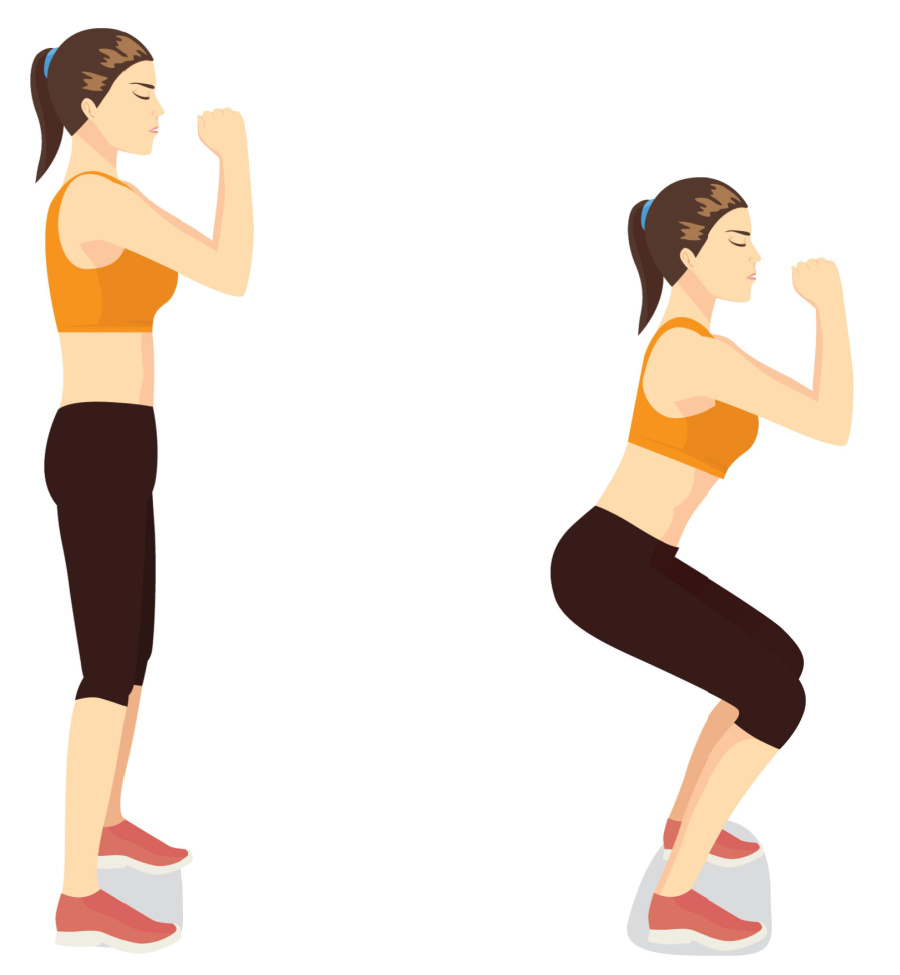
Squats are an overall excellent lower body, core, and functional exercise. Squats help us transition from sitting to standing, lift objects from the floor, and much more. When done correctly they engage our core muscles.
- Stand with feet hip width apart, chest up, and core engaged
- As you bend your knees, keep your knees over your feet and behind your toes by keeping your weight toward the heels as if you are going to sit in a chair.
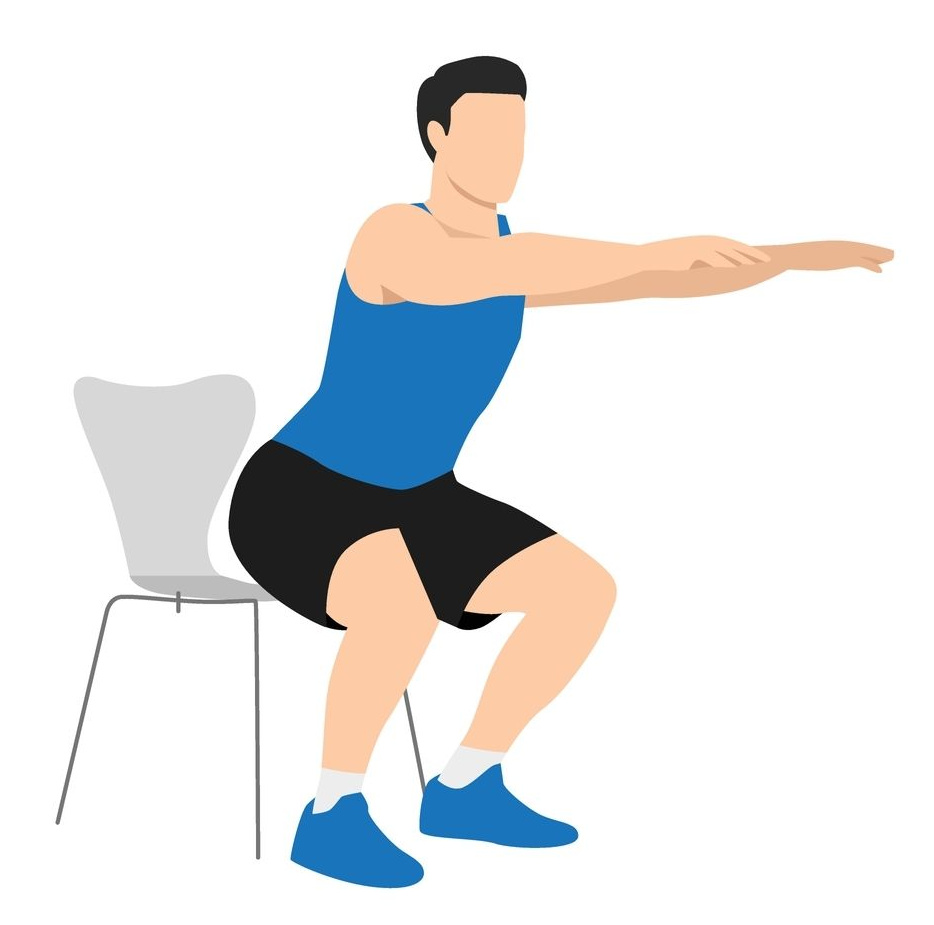
- It can help to have a chair behind you as a reminder but also as a gauge to make sure you are squatting to the same depth each time. Tap the chair each time you squat. If the chair height is too low, try the edge of a sofa or put a pillow on the chair seat to raise the height.
STEP UPS
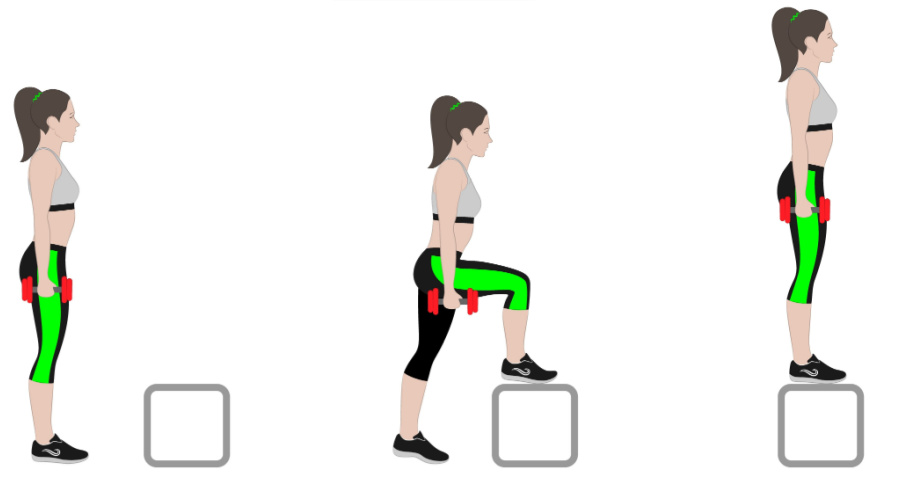
An alternative to squats for adding variety to your program is the step up exercise. These can be done to the front or side to target different muscle groups.
- Place 1 foot on a step
- Shift your weight over that foot and straighten the knee standing up
- AVOID jumping up with the foot on the ground. Make the step up leg do the work.
STANDING HEEL RAISES
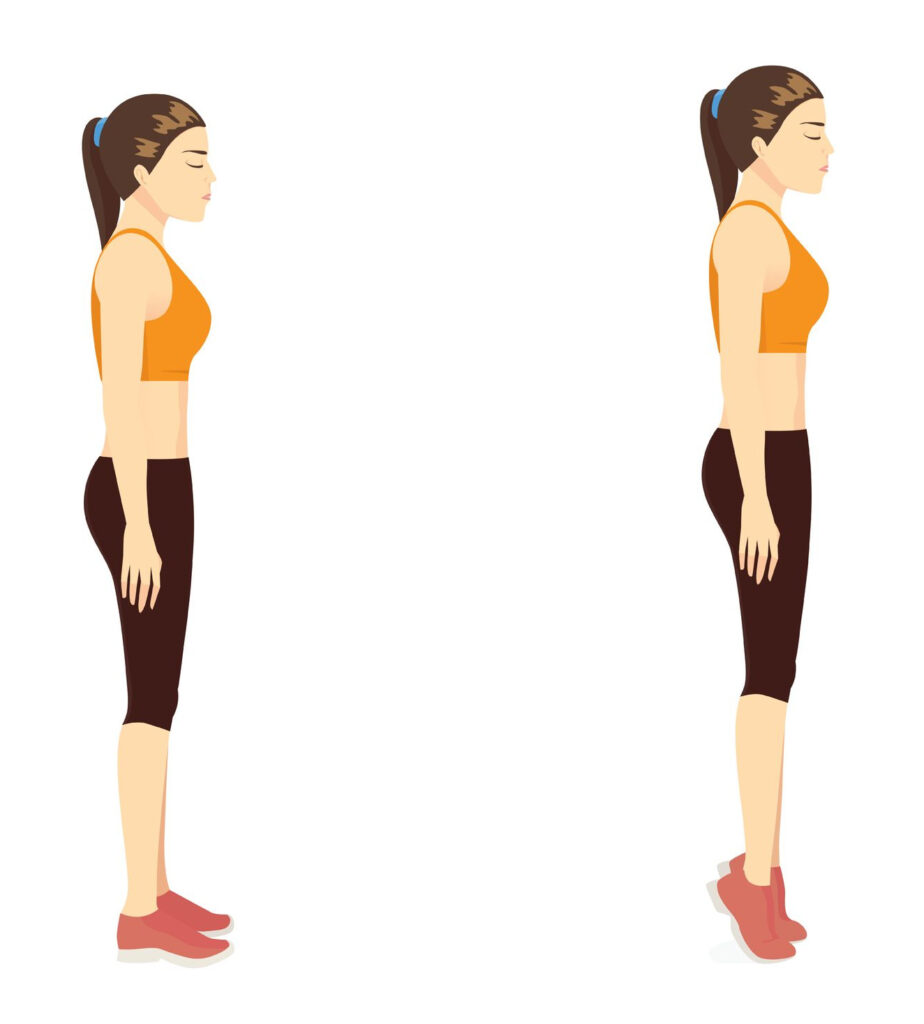
Standing heel raises strengthen the lower legs, ankles, and feet promoting ankle stability which is important for standing and walking activities. The improved strength and balance checks the deterioration that naturally happens with aging.
- Stand in a strong, tall posture with feet about hip width apart.
- While keeping your knees straight, lift the heels as high as you are able then slowly lower them back to the ground.
- Use balance support as needed.
PUSH UPS
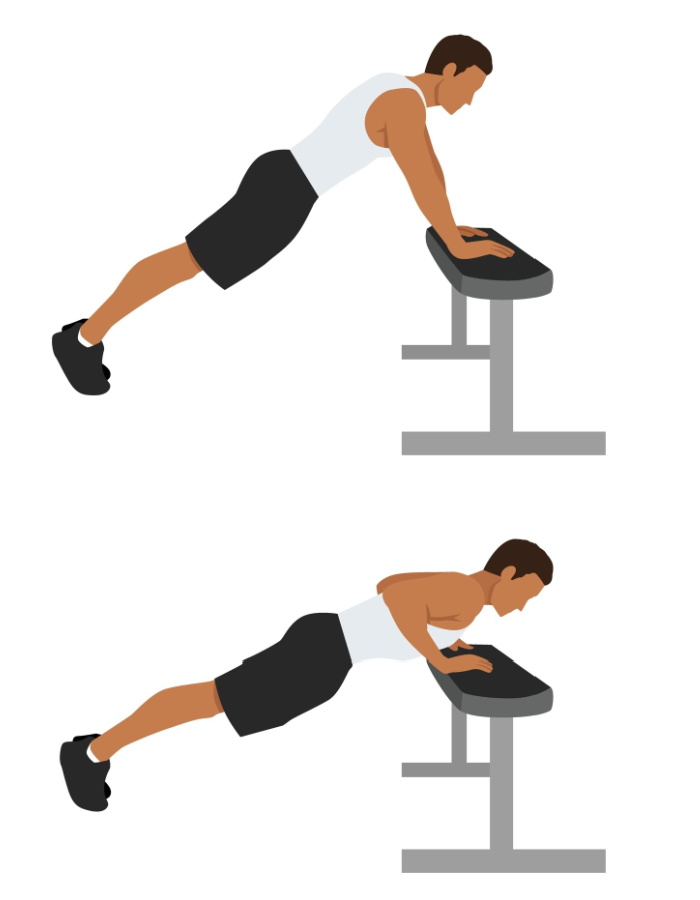
Push ups work the chest and shoulders as well as core muscles. Like squats they can be done almost anywhere and require minimal equipment. Never fear! There are many variations of push ups and there is an alternative for almost everyone: floor, knees, counter, wall, and more. In every variation of push up make sure that:
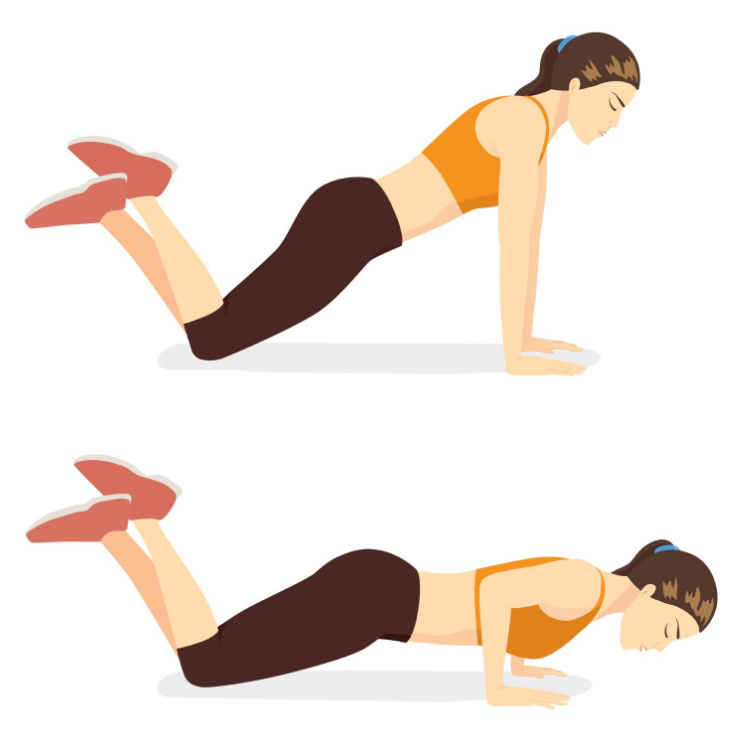
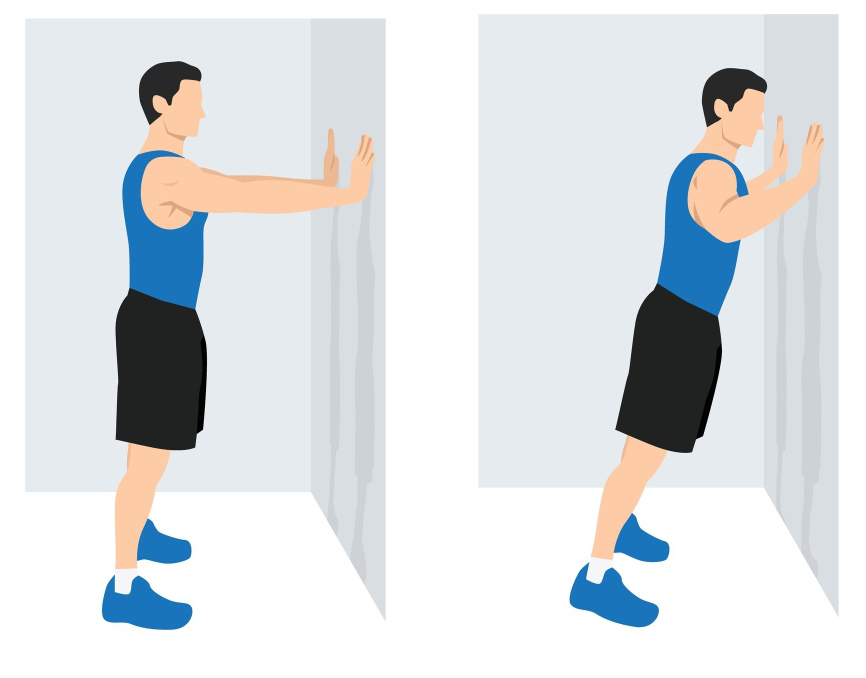
- The core is engaged and spine is straight, no dipping the belly or hips down.
- Bend the arms and bring the chest down, “Chest to deck” so to speak.
- Finish by pushing back to the starting position, again while keeping the core stable.
HINGE ROW (OR REVERSE FLY)
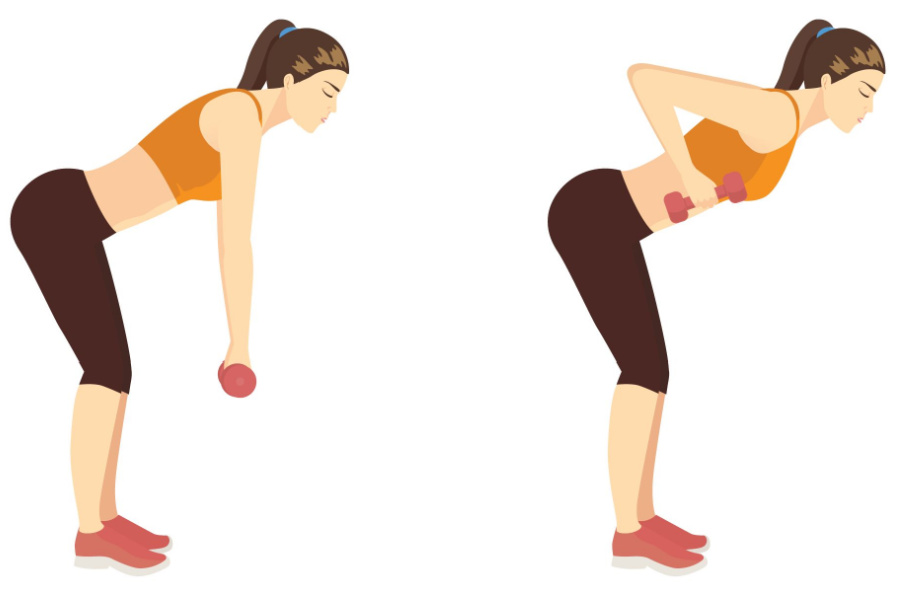
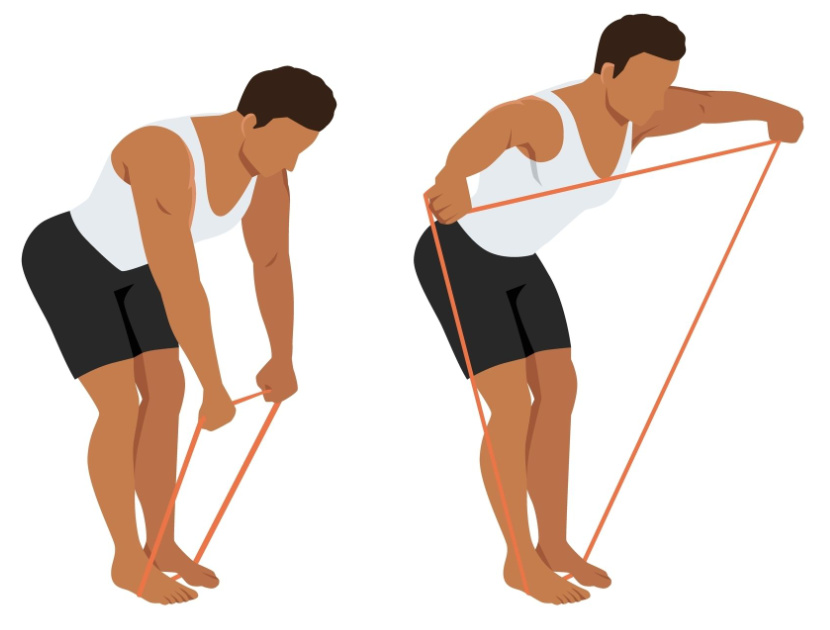
Especially as we age, strengthening of the upper back postural muscles helps us resist the rounded, hunched posture we associate with aging. The hinge row, or variation, strengthens the upper posterior chain as well as the core. You can use dumbbells or theraband for this exercise.
- Keeping the spine straight and long, bend at the hips, hinging forward to about 45 degrees. Your hands will hang to approximately your knees.
- While keeping your abdominal muscles engaged, glide your upper back muscles and shoulder blades toward the spine and down toward your low back.
- For a traditional row exercises the elbows will bend. For a reverse fly the elbows will stay straight.
BAR HANG
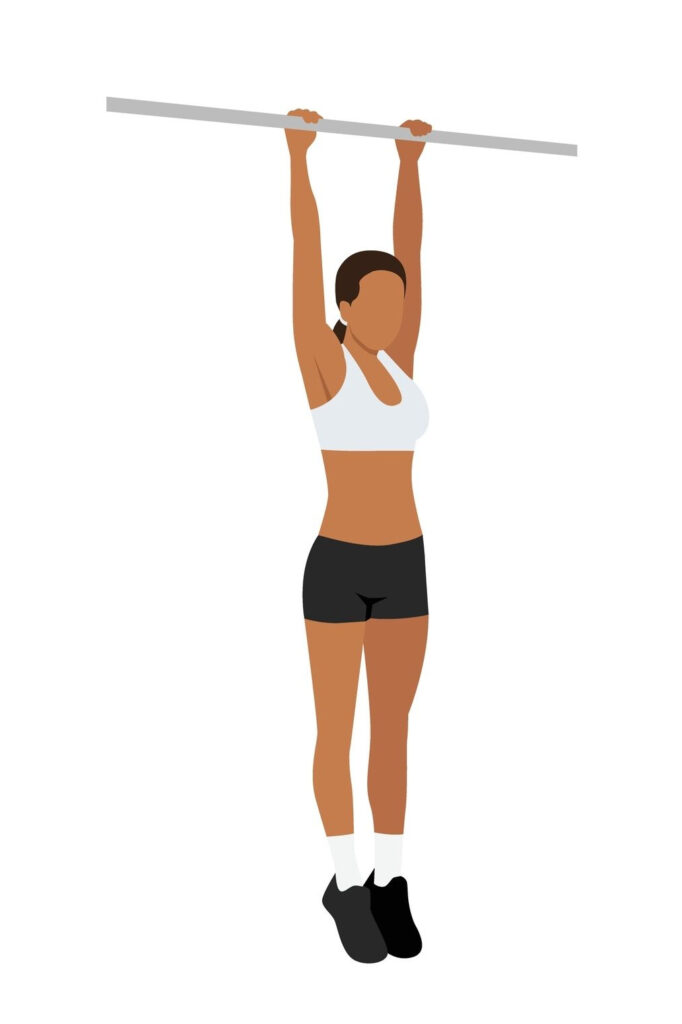
This may feel like the most intimidating exercise of the ones listed here but, your feet never need to leave the ground. You can simply start with your feet supported so that your muscles can get used to carrying the load. If you doubt me, my over 80 year old mother in law just installed a bar at her house and this is her new favorite exercise! The bar hang exercise enhances grip strength and shoulder mobility, strengthens the core and stretches the upper body. See this New York Times article, 5 Exercises to Keep an Aging Body Strong and Fit, for more detailed discussion of the bar hang exercise and ways to set this up in your home.
- Start with your feet supported so that muscles can become accustomed to bearing some tension.
- Place your hands about shoulder width apart. Wider if you need to accommodate stiff shoulders.
- Palms can face forward, toward your face, or mix it up with one forward and one toward face.
- Bend your knees and begin to put tension through your arms.
- Progress to an active hang, no foot support, when and if you are ready.
INCREASE THE EFFICIENCY OF YOUR SESSIONS
SUPERSETS
Supersets are a form of exercise where you focus on working opposing muscle groups back to back with little rest in between. Use this principle to decrease the needed rest time in between sets and increase the intensity of your strengthening session. This may even add a rise in heart rate so you can tick off a few of your cardiovascular training minutes at the same time! For example, while your legs are recovering from a set of squats, do a set of push ups. This gets you through all the exercises in less time.
UNSTABLE SURFACES
Unstable surfaces increase the core and balance components of any exercise. It’s easier to do squats on concrete than it is to do them on grass. Consider doing exercises on balance challenging surfaces such as thick carpet, foam cushions, or grass. Make sure you are safe and have something sturdy close at hand to grab on to if you lose your balance.
RESOURCES
Did you find this topic interesting? Below are more in depth articles.
- Aging human body: changes in bone, muscle and body fat – Journal of Endocrinology
- Muscle tissue changes with aging – National Library of Medicine
- Exercise sustains the hallmarks of health – Journal of Sport and Health Science
- To stay healthy in old age, research finds building muscles is key – The Washington Post
- How can strength training build healthier bodies as we age? – National Institute on Aging
- Take the 30-Second Power Test – The New York Times
- 30 Second Chair Stand Assessment – CDC
- Comparison of once‐weekly and twice‐weekly strength training in older adults – British Journal of Sports Medicine
- Dose–Response Relationships of Resistance Training in Healthy Old Adults: A Systematic Review and Meta-Analysis – Sports Medicine
- Tight on Time? How to Make the Most of a Short Workout. – They New Your Times
- Four Types of Exercise Can Improve Your Health and Physical Ability – National Institute on Aging
- 5 Exercises to Keep an Aging Body Strong and Fit – The NY Times
- The Power of the Squat – The New York Times
- Daily stair climbing is associated with decreased risk for the metabolic syndrome – BMC Public Health
- Effects of stair-climbing on balance, gait, strength, resting heart rate, and submaximal endurance in healthy seniors – Scandinavian Journal Medicine and Science in Sports
- Effects of Strength Training Using Unstable Surfaces on Strength, Power and Balance Performance Across the Lifespan: A Systematic Review and Meta-analysis – Sports Medicine
Joanne Bedwell, PT is the Resident Blogger at Be Active Be Well. She lives and works in San Francisco with her husband and two (almost) grown daughters. Having over 25 years of experience as a PT, she sees clients in their homes and teaches fitness classes in person and virtually.
DISCLAIMER: This article contains information that is intended to help the readers be better informed regarding exercise and health care. It is presented as general advice on health care. Always consult your doctor for your individual needs. Before beginning any new exercise program it is recommended that you seek medical advice from your personal physician. This article is not intended to be a substitute for the medical advice of a licensed physician. The reader should consult with their doctor in any matters relating to his/her health.
We provide in-home assessments in the San Francisco Bay Area. Contact us for a personalized Physical Therapy, Occupational Therapy, or Speech Therapy assessment.