
Is Your Glass Half Empty or Half Full?
Your answer might impact how long you live.
A growing body of research suggests that an optimistic mindset can improve health and extend lifespan. A 2022 Harvard study found that women with a positive outlook were more likely to live past 90—regardless of race. Wow!
This finding reaffirmed a 2019 study showing that higher levels of optimism are linked to a longer lifespan across different racial and socioeconomic backgrounds. Even when accounting for factors like income, health conditions, depression, smoking, diet, and alcohol use, the connection between optimism and longevity remained strong. Double wow!
Why Does Optimism Make a Difference?
According to Psychology Today’s The Science Behind the Behavior Blog, optimism influences health in four key ways:
1. Optimists Are Proactive About Their Health
Optimists tend to be more informed about how to maintain their health and are more likely to take preventive measures.
2. Optimists Engage in Healthier Behaviors
People with an optimistic mindset are more likely to:
- Exercise regularly
- Avoid smoking and consume alcohol in moderation
- Get better quality sleep
- Have fewer anonymous sexual partners
- Eat more fruits and vegetables
3. Optimists Cope Better With Setbacks
Psychologist Julia K. Boehm of Chapman University explains, “Optimism promotes problem-solving. It helps people deal with challenges and obstacles in more effective ways. In contrast, pessimists tend not to be open to the possibility of favorable outcomes, and the fight-or-flight response they experience can wear the body down over time.”
4. Optimists Have Stronger Social Networks
People with a positive outlook tend to build and maintain strong relationships, which provide crucial support during life’s challenges.
Are You an Optimist or a Pessimist?
The National Institutes of Health describes optimism as seeing “good things everywhere, being generally confident, and hopeful about the future.” Pessimists, on the other hand, “focus on the negative, have little hope, and tend to remain passive when faced with challenges.”
A quick online search for “Am I an optimist or a pessimist?” yields a plethora of self-assessment quizzes. But most of us likely already know our tendencies. Here’s how experts define optimism:
- “Optimists acknowledge negative events, but they are less likely to blame themselves, view setbacks as temporary, and expect better outcomes in the future.” – Dr. Aparna Iyer, psychiatrist and professor at the University of Texas Southwestern Medical Center
- “Positive thinking doesn’t mean ignoring life’s stressors. It means approaching hardship in a more productive way.” – Kimberly Hershenson, LMSW
Yikes! I’m a Pessimist. Can I Learn Optimism and Live Longer Too?
Yes! The good news is that optimism can be learned. Studies show that by consciously altering thought patterns, you can literally rewire your brain. In one study, workers in high-stress jobs who leaned toward pessimism were taught mindfulness techniques. After just two months of training (three hours per week), participants reported feeling less anxious, more energized, and happier.
Dr. Alan Rozanski, a cardiologist at Mount Sinai St. Luke’s Hospital, recommends these steps for shifting to a more optimistic mindset:
- Commit to changing how you view situations
- Catch yourself when thinking negatively
- Recognize that there’s more than one way to interpret a challenge
- Substitute a better, more constructive thought
6 Ways to Train Yourself to Be More Optimistic

1. ‘Try On’ a Positive Lens
Challenge yourself to see situations in a different light. Over time, this can train your brain to think more positively.
2. Take Note of the Company You Keep
Negativity is contagious. Surround yourself with uplifting people.
3. Limit Exposure to Negative News
Stay informed but avoid the 24-hour cycle of doom.
4. Keep a Gratitude Journal
Each night, write down one or two things you’re grateful for. If you’re unsure where to start, try prompts like:
- What was a small but special moment today? It could be a cup of coffee or the feel of the breeze.
- What is something in your home you treasure? Why?
- What is a challenge you overcame to get you to where you are today?
- Name something beautiful that you saw today.
5. Focus on What You Can Control
Accept uncertainty and practice mindfulness to reduce stress.
6. Acknowledge the Negative Without Dwelling on It
Being optimistic doesn’t mean ignoring reality; it means balancing positivity with realism.
Real-Life Optimism in Action
Want proof that optimism makes a difference? Here’s what a few inspiring individuals have to say:
Grace Harvey, 100, LaGrange, Georgia
“Even though you would classify us as poor, I didn’t think of myself as poor. I just thought of myself as blessed to have parents doing the best they could.”
Katharine Esty, 88, Concord, Massachusetts
“Letting go of what we think life should be and embracing what is leads to greater happiness. Optimism is a choice.”
Ron Fegley, 82, Placer County, California
“We don’t know what’s going to happen. But we enjoy our life now, and we’re going to keep enjoying it as much as we can.”
Patricia Reeves, 73, Oklahoma City
“You don’t dwell on aches and pains. You acknowledge them, solve what you can, and move forward.”
Anita Lerek, over 65, Toronto
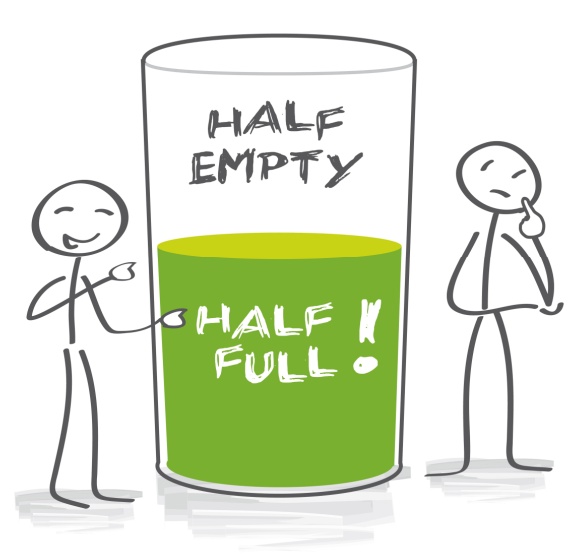
“It boils down to this: Is the glass half-empty or half-full? I choose the fullness.”
Final Thoughts
So, is your glass half empty or half full? Science suggests that how you answer might just help you live a longer, healthier life. And the best part? Optimism isn’t just an innate trait—it’s a skill you can develop.
The takeaway? A brighter outlook might just lead to a longer, healthier life. And that’s definitely something to smile about!
Here are some great resources for further reading:
- Daily Anchors: 90 Days of Simple Habits for a Positive and Healthy Mindset, by Andi Dehne
- Looking on the Bright Side May Be Good for Your Health , New York Times
- Are You an Optimist? Your Health May Depend on It., US News
- How to Train Your Brain to Be More Optimistic, ABC News
- Optimism lengthens life, study finds, Harvard Gazette
Be Active Be Well
We provide in-home consultations in the San Francisco Bay Area. Contact us for a personalized Physical Therapy, Occupational Therapy, or Speech Therapy assessment in the San Francisco Bay Area: Santa Clara, San Mateo, San Francisco, and Marin Counties.
Joanne Bedwell, PT, is the Resident Blogger at Be Active Be Well. Based in San Francisco, she lives with her husband and two nearly grown daughters. With over 25 years of experience as a physical therapist, she provides in-home client care and teaches fitness classes both in person and online.
DISCLAIMER: This article contains information that is intended to help the readers be better informed regarding exercise and health care. It is presented as general advice on health care and is not intended to be a substitute for the medical advice of a licensed physician. Before beginning any new exercise program it is recommended that you seek medical advice from your personal physician. The reader should consult with their doctor in any matters relating to his/her health.