
Is your glass half empty or half full?
Your answer to this question could have impact on how long you will live.
There is a growing body of research that an optimistic mindset can improve your health and help you live longer. A 2022 Harvard study found that women who reported positive outlook were likelier to live past 90, regardless of race. Wow! This affirmed a 2019 study in finding that higher levels of “optimism” are associated with a longer lifespan across different races and backgrounds. Even when socioeconomic status, health conditions, depression, smoking, social engagement, poor diet, and alcohol use were considered, the link between optimism and longevity remained. Double Wow!
Why does optimism make a difference?
According to Psychology Today’s The Science Behind the Behavior Blog, there are 4 factors.
- Optimists know more about their own health and about how to be healthy: We must know how to be healthy in order to be healthy.
- Optimists engage in healthier behaviors. Optimistic people:
- Tend to exercise more
- Are less likely to smoke and more likely to drink only moderate levels of alcohol
- Get more sleep and better quality sleep
- Have fewer anonymous sexual partners
- Eat more fruits and vegetables
- When facing a setback, optimists use more effective methods to deal with it: According to Julia K. Boehm, a psychologist at Chapman University in Orange, Calif., “Optimism promotes problem-solving. It helps people deal with challenges and obstacles in more effective ways. In contrast, pessimists tend not to be open to the possibility of favorable outcomes, and the fight-or-flight response they experience amps up bodily systems that over a long period of time wear the body down.”
- Optimists have better social networks: People with stronger social networks receive greater support after adverse health events.
Is your glass half empty or half full?
From The National Institutes of Health: “An optimistic person sees good things everywhere, is generally confident and hopeful of what the future holds. The pessimist, on the other hand, observes mainly the negative aspects of everything around. The pessimist is likely to have little hope for the future. Consequently, the pessimist tends to remain passive when encountered with a challenge, believing that his efforts are futile anyway.”
A quick Google search of “am I an optimist or pessimist” yields a plethora of self quizzes. Most of us likely know our tendencies but here are some thoughts from experts about what optimism is and is not.
- “Optimists do acknowledge negative events, but they are more likely to avoid blaming themselves for the bad outcome, inclined to view the situation as a temporary one and likely to expect further positive events in the future.” Dr. Aparna Iyer, psychiatrist and assistant professor at the University of Texas Southwestern Medical Center.
- “Positive thinking doesn’t mean that you ignore life’s stressors. You just approach hardship in a more productive way.” Kimberly Hershenson, LMSW
Yikes, I’m a pessimist! Can I learn optimism and live longer too?
There is good news here. According to experts, by consciously altering your thought processes, you can literally re-wire your brain. In one study, mindfulness was taught to workers in high-stress jobs who, on average, tipped toward pessimism. After two months of training (for three hours each week), the workers reported feeling less anxious, more energized, and happier.
From the NYT article, Looking on the Bright Side May Be Good For Your Health, Dr. Rozanski is a cardiologist at Mount Sinai St. Luke’s Hospital in New York advises:
- Make a commitment to change how you look at things
- Catch yourself when thinking negatively
- Recognize that there is not only one way to think about a situation
- Substitute a better thought that is credible
6 Ways to Train Yourself to Be More Optimistic
- ‘Try On’ a Positive Lens: Experts refer to the tactic as “positive reframing.” Challenge yourself to consider that there are other ways of looking at things. Making this conscious effort not only impacts your mood right now, but over time it may actually train your brain to think more positively.
- Take Note of the Company You Keep: Negativity is contagious.
- Turn Off the News: Consume just enough news to stay informed. Avoid the constant 24 hour news cycle’s constant barrage of negativity.
- Write in a Journal for a Few Minutes Each Day: At the end of each day write down one or two things that filled you with gratitude. Facing a blank journal page can be daunting. There are many journals available to help you such as Daily Anchors by Andi Dehne
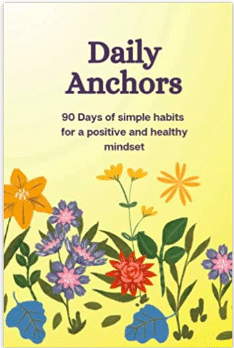
and internet sources of “gratitude” prompts. Some of my favorite prompts are:
- Reflect on your day and notice a small moment that was actually quite special, like enjoying your cup of coffee or going for a walk.
- Name something in your home that you truly treasure. Why?
- Name one or two things you experienced today that delighted you.
- Who is someone that makes me feel seen in my day-to-day life?
- Spot three things around you right now that you are glad you don’t have to live without.
- Name one good thing that happened today.
- What’s a challenge you overcame to get you to where you are today?
- List three qualities you admire about yourself.
- Name something beautiful that you saw today.
- List a sight, a sound and a feeling that reminds you that life is amazing.
- Acknowledge What You Can — and Cannot — Control: Uncertainty is uncomfortable. Accept what you cannot control. Practicing mindfulness is a great way to help combat the tendency to ruminate over daily stressors.
- Don’t Forget to Acknowledge the Negative: It’s important to remember that making an effort to be more optimistic doesn’t mean walking around wearing rose-colored glasses. A combination of optimism and realistic thinking help people navigate through life.
Now for some inspiration from the “real” experts
What does optimism look like in practice?
- Grace Harvey, 100, LaGrange, Georgia – “Even though you would classify us as poor, I didn’t think of myself as poor. I just thought of myself as blessed to have parents doing the best they could.”
- Katharine Esty, 88, Concord, Massachusetts – “Letting go of our inner vision of what our life should be and being open to what’s really happening. I have come to think that you choose your attitude, and optimism is an attitude,”
- Ron Fegley, 82, Placer County, California – “We don’t know what’s going to happen; no one does. But we enjoy our life currently, and we’re just going to go on enjoying it as much as we can.”
- Patricia Reeves, 73, Oklahoma City – “You don’t spend your time concentrating on your health or thinking about your aches and pains. You take them in as a fact, and then you let them go. Or if you’ve got a problem you can solve, you figure out how to solve it, and you move on to tomorrow.”
- Anita Lerek, over 65, Toronto – “It boils down to, ‘Is the glass half-empty or half-full?’ I choose the fullness.”
RESOURCES
Did you find this topic interesting? Below are some more in depth articles.
- Looking on the Bright Side May Be Good for Your Health New York Times
- Are You an Optimist? Your Health May Depend on It. US News
- Do optimists live longer? Of course they do CNN Health
- 4 Reasons Why an Optimistic Outlook Is Good for Your Health Psychology Today
- How to Train Your Brain to Be More Optimistic ABC News
- Psychologist shares the No. 1 exercise highly successful people use to be happier CNBC
- Chronic stress can affect your health. One activity can help CNN Health.
- Optimism lengthens life, study finds Harvard Gazette
Joanne Bedwell, PT is the Resident Blogger at Be Active Be Well. She lives and works in San Francisco with her husband and two (almost) grown daughters. Having over 25 years of experience as a PT, she sees clients in their homes and teaches fitness classes in person and virtually.
DISCLAIMER: This article contains information that is intended to help the readers be better informed regarding exercise and health care. It is presented as general advice on health care. Always consult your doctor for your individual needs. Before beginning any new exercise program it is recommended that you seek medical advice from your personal physician. This article is not intended to be a substitute for the medical advice of a licensed physician. The reader should consult with their doctor in any matters relating to his/her health.
We provide in-home assessments in the San Francisco Bay Area. Contact us for a personalized Physical Therapy, Occupational Therapy, or Speech Therapy assessment.