
Know Skin Cancer Signs

I grew up in a time when tanning was trendy and sunscreen was optional.
Born in 1965 and raised under the bright California sun, I grew up in a time when tanning was trendy and sunscreen was optional. Like many families then, mine didn’t fully understand, or even consider, the long-term risks of sun exposure. We spent endless summer days by the pool, on the blacktop, or at the beach, often with little more than a splash of SPF 4 tanning oil (if anything at all).

That legacy of sun exposure started before me. My mother, born in 1930, spent her childhood and teen years in sun-soaked San Pedro, California, long before sunscreen was a household word. Decades later, she would have numerous skin cancers removed from her face and arms. One so extensive that it required the removal of a significant amount of tissue and left her with a visible deformity on her ear.
Back then, public awareness about the dangers of UV radiation and skin cancer was limited. And let’s be honest, when you’re a teenager, you tend to believe you’re invincible. The idea that those golden tans might lead to something as serious as skin cancer felt distant, if it even crossed our minds at all.
Now, decades later, I’ve come to learn just how crucial it is to recognize the signs of skin cancer early and why regular dermatology checkups can truly be lifesaving.
Understanding the Types of Skin Cancer
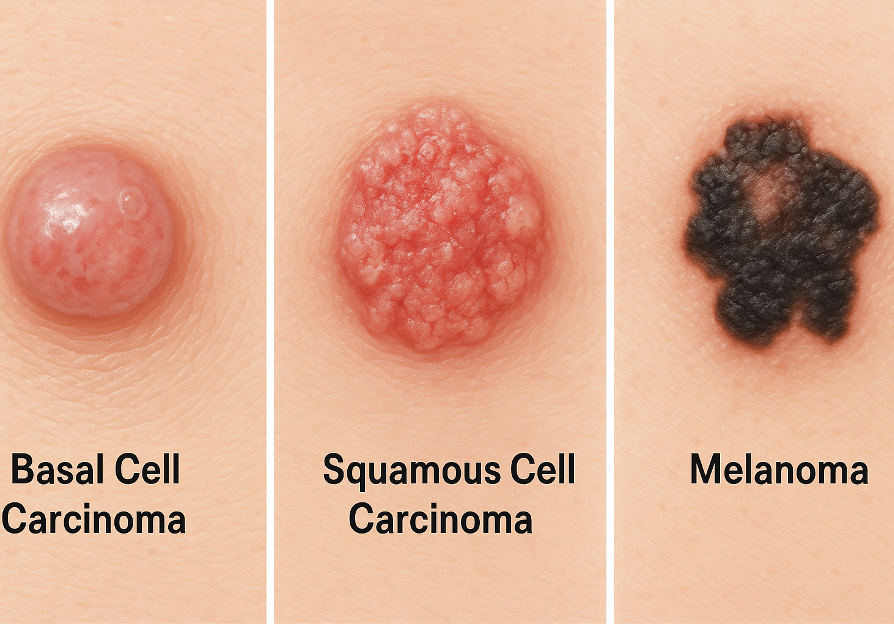
Basal Cell Carcinoma
- Most common, least aggressive
- Often appears as a pearly bump or pink patch
- Grows slowly but can cause local tissue damage if untreated
Squamous Cell Carcinoma
- Can be more aggressive
- May look like a scaly red patch or open sore
- Treatable when caught early
Melanoma
- Less common but most dangerous
- Can develop in existing moles or on normal skin
- Early detection is critical
The ABCDEs of Melanoma: What to Look For
When checking your skin for signs of melanoma, the most dangerous form of skin cancer, the ABCDE rule is a helpful tool. It can guide you in identifying moles or spots that may need a professional evaluation:
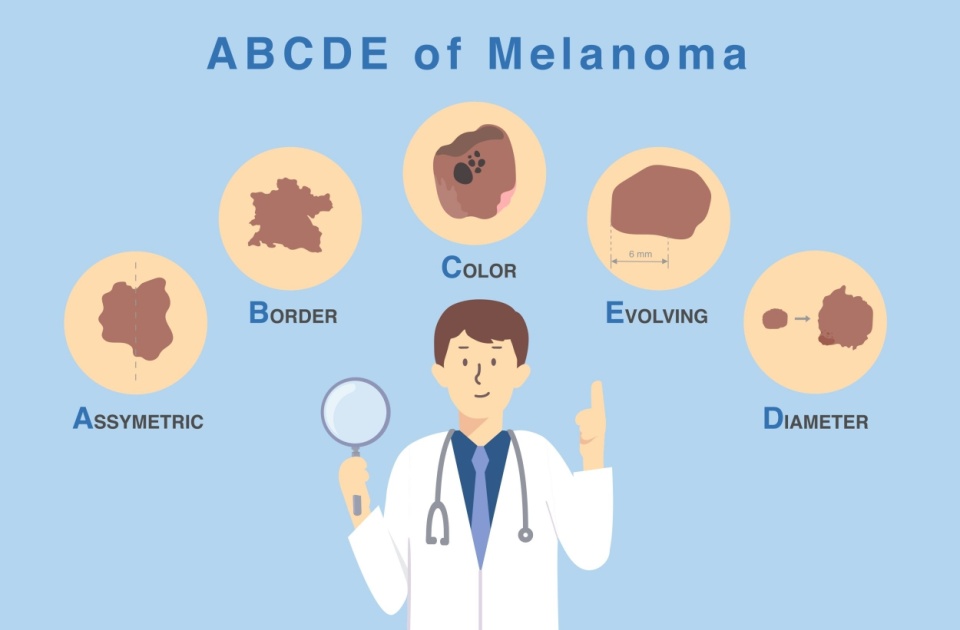
A – Asymmetry
One half of the mole doesn’t match the other. If you were to draw a line through the center, the two halves would look different. Benign (non-cancerous) moles are usually symmetrical.
B – Border
Melanomas often have uneven, scalloped, or jagged borders. A normal mole typically has smooth, even edges that are clearly defined.
C – Color
Look for multiple colors or uneven distribution of color—shades of brown, black, red, white, or blue may appear in a single lesion. Benign moles are usually a single, uniform color.
D – Diameter
Melanomas are often larger than 6 millimeters (about the size of a pencil eraser), though they can be smaller when first detected. It’s important to monitor both size and any growth over time.
E – Evolving
Any change in size, shape, color, elevation, or behavior (such as bleeding, itching, or crusting) can be a warning sign. Moles that start to evolve over time deserve prompt attention from a dermatologist.
My dermatologist sums it up simply. If it’s BROWN and ROUND it’s a normal mole. If not, it needs to be looked at by a professional.
🔗 American Academy of Dermatologists: How To Perform A Self Skin Check
Other signs to watch for:
- New growths or moles
- Sores that don’t heal
- Itching, bleeding, or crusting lesions
If a mole or spot shows any of these signs, don’t wait. Get it checked by a dermatologist.
Do You Need a Dermatologist on Your Medical Team?
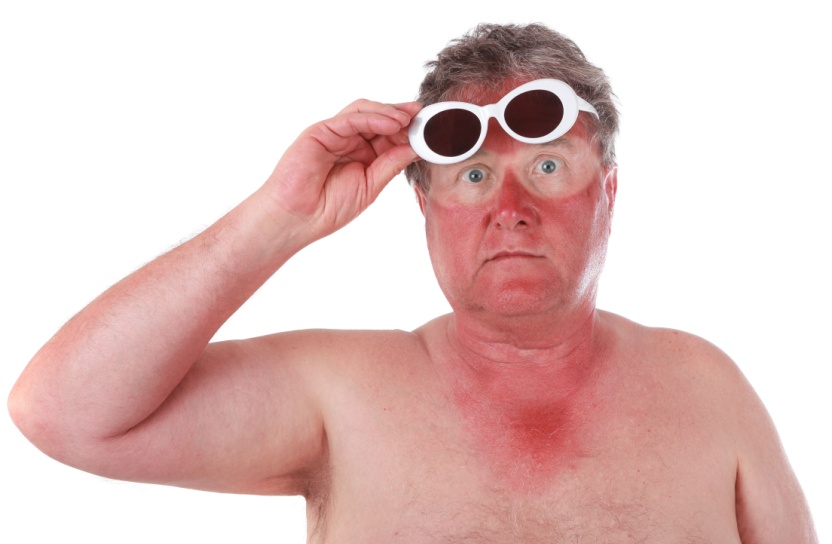
Dermatologists aren’t just for cosmetic issues. They save lives. yearly full-body skin checks are essential if:
- You have a history of sunburns or regular tanning
- You have many moles or light skin
- You’ve had a skin cancer before
How a Skin Check Works
If you’ve never had a professional skin check, it might sound intimidating, but it’s actually quick, simple, and completely non-invasive. During the exam, a dermatologist carefully examines your skin from head to toe, looking for any spots, moles, or marks that appear unusual or have changed over time. You’ll typically wear a medical gown, and they may use a special magnifying tool called a dermatoscope to get a closer look at certain areas.
The whole process usually takes just 10–20 minutes. There are no needles, no pain, and no prep needed. If anything looks suspicious, the dermatologist may take a photo, recommend monitoring, or in some cases suggest a quick biopsy. Most people leave feeling relieved and empowered, knowing they’ve taken an important step in protecting their health.
Early detection can mean the difference between a minor procedure and a life-threatening illness.
A Note About Skin Cancer Detection Apps
While there are several smartphone apps that claim to analyze moles or detect potential skin cancers using artificial intelligence, the American Academy of Dermatology (AAD)(AAD) does not currently recommend relying on these tools. Studies have shown that the accuracy of these apps can vary significantly, and they may miss dangerous lesions or create false alarms. They are not a substitute for a professional skin exam. If you notice something suspicious, it’s best to see a board-certified dermatologist—no app can replace the trained eye of a medical expert.
Final Thoughts
With what I know now, I’ve taken a much more proactive approach with my children. Even now, as young adults, I continue to encourage sunscreen and sun-protective clothing. While they’ve had the occasional sunburn, they’ve had far fewer than I did growing up.
It’s never too late to start protecting your skin—or to be a role model for those you love. Don’t wait for a diagnosis to take sun safety seriously. Make it a daily habit: wear sunscreen, seek shade, and wear a hat. And don’t forget to schedule regular skin checks.
🔗 Learn more:
- ABCDEs of melanoma – American Academy of Dermatology
- How To Perform A Self Skin Check – American Academy of Dermatology
- Health and Wellness Apps that Dermatologists Do and Do Not Recommend – American Academy of Dermatology
- Smart Sun Protection: Tips for Using SPF the Right Way – Be Active Be Well Blog
Ready to get moving again—safely and confidently?
Whether you’re dealing with chronic pain, recovering from an injury, or simply feeling stuck, our expert team is here to help. We offer personalized Physical Therapy, Occupational Therapy, and Speech Therapy assessments, all from the comfort of your home. Contact us today to get started!
Serving the San Francisco Bay Area—including Santa Clara, San Mateo, San Francisco, and Marin Counties—we bring compassionate, evidence-based care right to your doorstep.
Joanne Bedwell, PT, is the Resident Blogger at Be Active Be Well. Based in San Francisco, she lives with her husband and two nearly grown daughters. With over 25 years of experience as a physical therapist, she provides in-home client care and teaches fitness classes both in person and online.
DISCLAIMER: This article contains information that is intended to help the readers be better informed regarding health care issues. It is presented as general advice on health care and is not intended to be a substitute for the medical advice of a licensed physician. The reader should consult with their doctor in any matters relating to his/her health.